

Island of St. Kirrik and Julita Shelter a Museum of Underwater Archeology
We will turn the former naval school to St. Kirik and Julita at the Museum of Underwater Archeology. Within a year and a half – two this place will become an island of art thanks to a project we are working with together with the Louvre. This is only a part of the promises that the Minister of Culture Boil Banov gave on the BTV in the early days of the newyear 2019.
Many of our and foreign scientists are already seeing a worthy end to their research. The results of the 4-year international Black Sea Maritime Archaeological Project (Black Sea Maritime Archaeological Project) in the Bulgarian Black Sea aquatory were presented in Bulgaria at the end of 2018 and before that with a documentary film on the BBC. Estimates in scientific circles around the world are extremely high, and the hopes of those involved with the project are the results of their work being accessible to a thematic museum. In the team led by Professor John Adams, founder and director of Southampton University’s Marine Archeology Center, are Edward Parker, Executive Director of EEF Expeditions and Black Sea MAP, Dr. Kalin Dimitrov, Director of the Center for Underwater Archeology in the town of Sozopol, Assoc. Prof. Lyudmil Vagalinski, former Director of the National Archaeological Institute with a museum at the Bulgarian Academy of Sciences, as well as dozens of specialists in various fields of science. According to Professor Adam, the expedition has carried out one of the most extensive and high-tech research on the Black Sea bottom (100 days at sea and 40 under water).
Why is it good to create a museum of underwater archeology in Bulgaria? For the first time, the Black Sea MAP has applied the most advanced technology used so far only for industrial purposes to explore more than 2000 square meters of the seabed. The remains of 65 ships from all ages from Antiquity to the Ottoman period were discovered, scientists say. One of the most impressive finds is a vessel identical to the vessel depicted on the famous ancient Greek “Vase with the sirens” from the end of the 5th century BC, which is located in the British Museum. Until recently, the painting was considered the result of a author fantasy, but the find proves that such vessels really existed. The underwater archaeologists of joke call their discovery “The Ship of the Odyssey”. However, they are very serious when they say that this is the oldest and best-kept ship known so far.
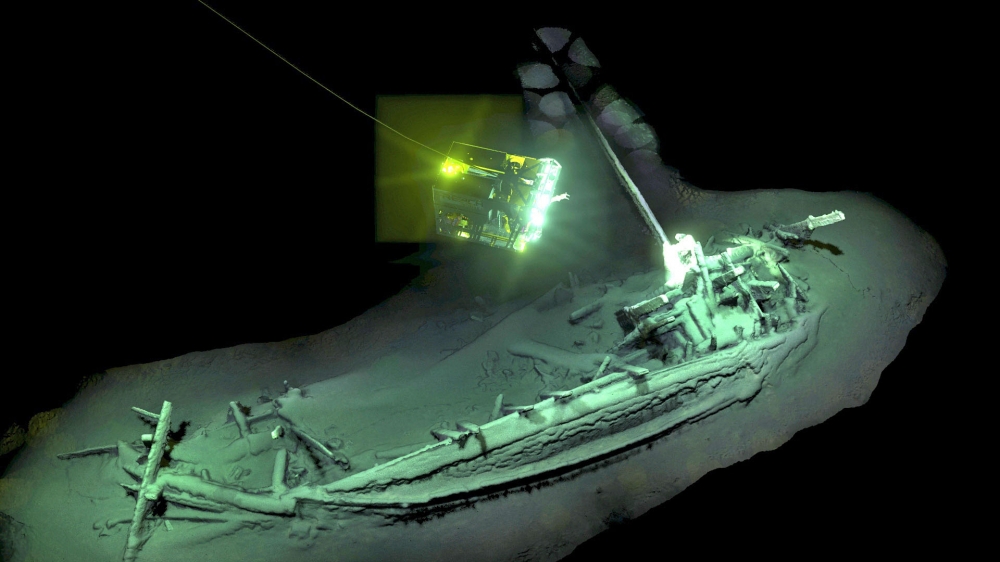
The dating of the 2 km under water vessel was determined using the radioactive carbon method. There the water is anoxic (without oxygen), thanks to which the tree has been preserved for millennia. However, it appears that despite the lack of oxygen at this depth, anaerobic bacteria grow.
“We knew we would find shipwrecks, but their numbers and condition amazed us,” says Professor Adams. – The same is true of the existence of bacteria unknown to science that are still active in thousands of years. This will enrich the understanding of the specific anoxic environment where some of the most important pieces of the world’s cultural heritage are to be discovered. ”
Among the other finds of the expedition were totally preserved, probably Genoese, a medieval vessel coinciding with the ideas of Marco Polo’s ship; half a corps of a Byzantine ship of 950; another vessel of the 1st or 2nd century from the fleet of the Emperors Trajan or Adrian; a squadron of identical boats, probably from a fleet of Cossacks who often attacked Ottoman ships in the 18th century, and others. Removal of some of them is not foreseen, as it would cause them irreparable damage. In the future museum, however, via virtual reality visitors will be able to “immerse” in the mysterious underwater world.
SUPPORT US
If you want to support our efforts and work, you can do so by donating funds, voluntary work, work materials or expert support!